Colonnes de mesure
 CMM portable
 Bras de mesure portables
 Bancs de mesure et de préréglage
 Bancs de mesure et d'étalonnage
 Aberlink CMM
 Systèmes de préréglage d'outils
 Systèmes de Frettage d'outils
 Systèmes de montage d'outils
 Instruments de mesure optique de surface
 Aberlink
 Notre entreprise
 My-Trimos
 Trimos dans le monde
 Garantie
 Actualités
 Politique de confidentialité
 Emplois
 Demande de prix
 Demande de démonstration
 Demande de service
 Autre contact
Qu'est-ce qu'une colonne de mesure
Une colonne de mesure est un instrument universel utilisé dans les ateliers pour mesurer rapidement et précisément les dimensions des pièces mécaniques. Cet instrument polyvalent est essentiel pour la fabrication, l'ingénierie et le contrôle de la qualité.
Les colonnes de mesure sont principalement conçues pour mesurer les hauteurs, les longueurs, les distances, les diamètres et l'équerrage des pièces. Leur principal succès dans l'atelier est dû à leur facilité d'utilisation et à leur rapidité de mesure.
Il existe différents types de colonnes de mesure, qui peuvent être sélectionnés en fonction des besoins, des applications et du budget de l'entreprise.
What Is a Height Gauge Used For?
A height gauge is primarily used to measure the position of features on a workpiece relative to a reference surface.
Typical height gauge measurements include:
- Height measurements
- Distances between features
- Diameter measurements of cylindrical features
- Centerline measurements
- Thickness measurements
- Squareness and perpendicularity
- Angles and cones with advanced 2D height gauges
- Marking out precise dimensions on a workpiece
The exact measurement capabilities depend on the height gauge, measuring probe and accessories being used.
How Does a Height Gauge Work?
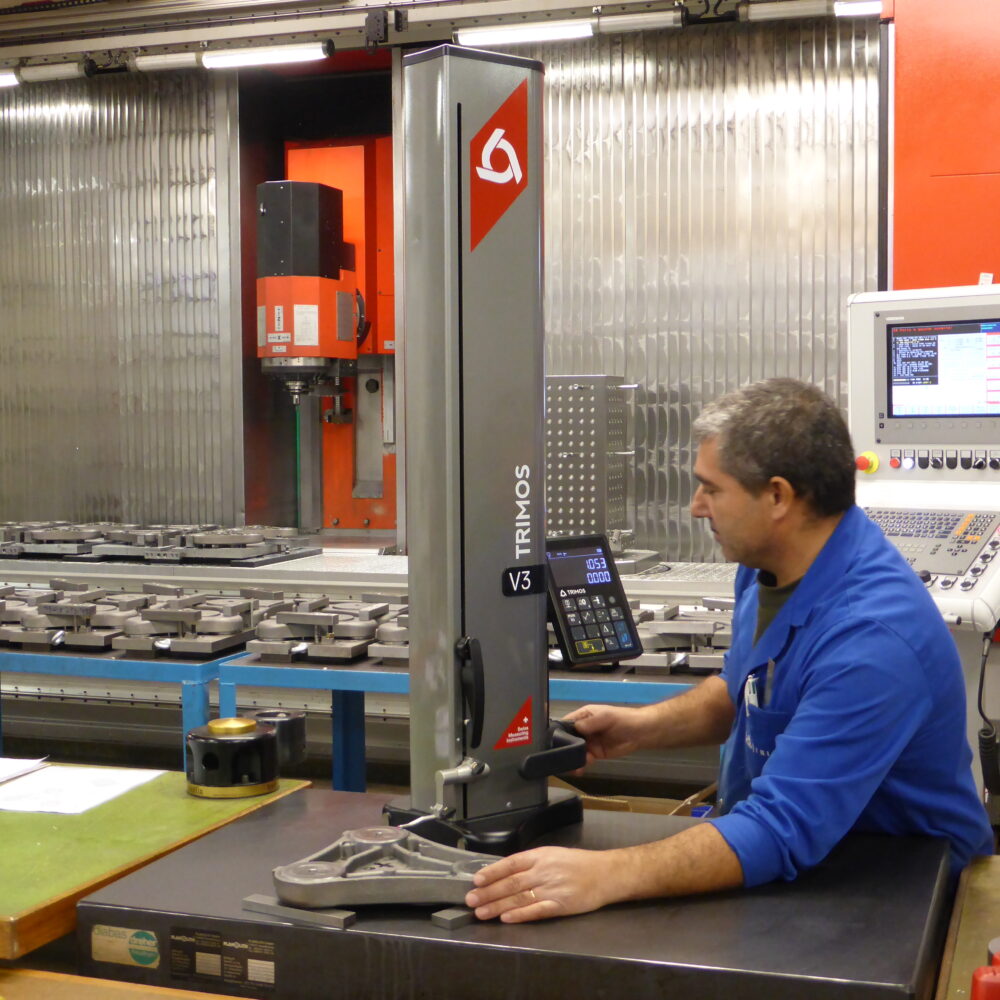
A height gauge works by moving a measuring probe along a vertical measuring axis. The instrument is placed on a precision surface plate, which provides the reference plane. The workpiece is placed on the same surface. The operator then positions the measuring probe against the feature to be measured. The height gauge determines the distance between the reference surface and the measured feature.
Modern electronic height gauges provide a digital measurement display and, depending on the model, additional functions such as data transfer, measurement guidance and programmed measurement sequences.
What Can You Measure With a Height Gauge?
A height gauge is a versatile dimensional measuring instrument. Depending on its configuration, it can be used for:
Height and Distance Measurements
The most basic application is measuring the vertical distance between the reference surface and a feature on the workpiece. This includes measuring steps, shoulders, surfaces, grooves and other features.
Diameter and Centerline Measurements
A height gauge can measure cylindrical features such as holes and shafts. The measurement can be used to determine the diameter and centerline position of a feature.
Some Trimos height gauges include dedicated functions designed to make diameter and centerline measurements faster and easier.
Squareness and Perpendicularity
A suitable indicator or electronic probe can be used to check the perpendicularity of a feature relative to the reference surface. This is useful when inspecting machined components where the orientation of a surface or feature is important.
2D Measurements
Advanced 2D height gauges extend the capabilities of a conventional height gauge. Depending on the instrument, 2D measurement functions can include diameters, centerlines, angles, cones, perpendicularity and other geometric measurements.
For example, the Trimos V7 and V9 provide graphical assistance for 2D measurements, including diameter and angle measurements.
Scribing
A height gauge can also be fitted with a scriber or suitable marking insert to transfer precise dimensions onto a workpiece. This makes height gauges useful not only for inspection but also for preparation and marking-out operations in workshops. Exemple: Trimos V1
What Are the Different Types of Height Gauges?
Height gauges are available in different configurations depending on the required measurement capabilities and working environment.
Manual Height Gauges
Manual height gauges use operator-controlled carriage movement.They are well suited to straightforward dimensional measurements and workshop inspection.
Digital Height Gauges
Digital height gauges use an electronic measuring system and digital display, making measurements easy to read and record. Modern digital instruments can also provide data interfaces for transferring measurements to external systems.
Motorized Height Gauges
Motorized height gauges use powered carriage movement to simplify positioning and repetitive measurements.
Some instruments combine manual and motor-driven movement, allowing the operator to select the most appropriate mode for the application. The Trimos V5, for example, combines manual and motor-driven carriage displacement.
1D Height Gauges
A 1D height gauge is primarily designed for measurements along the vertical measuring axis. It is suitable for common height, distance and dimensional inspection tasks.
2D Height Gauges
A 2D height gauge provides additional measurement capabilities beyond a simple vertical height measurement.
Depending on the model, it can perform measurements such as diameters, centerlines, angles and perpendicularity, often with graphical assistance.
Where Are Height Gauges Used?
Height gauges are used wherever accurate dimensional inspection is required. Common applications include:
- Machine shops for checking machined components
- Quality control for verifying dimensions and tolerances
- Manufacturing for in-process and final inspection
- Toolrooms for measurement and scribing
- Metrology laboratories for precision dimensional measurement
- Engineering for prototype and component inspection
One of the advantages of a height gauge is that it can be used close to the machining or production area, allowing operators to perform many measurements without sending every component to a dedicated CMM or metrology laboratory. Trimos positions its height gauges for both workshop and laboratory use.
Height Gauge vs. Other Measuring Instruments
A height gauge occupies a specific place in dimensional measurement.
Unlike a handheld caliper, which is used directly on a component for a variety of dimensions, a height gauge uses a reference surface to establish the position of a feature.
Compared with a coordinate measuring machine (CMM), a height gauge is particularly suited to measurements referenced to a surface plate and can provide a practical solution for many workshop and production measurements.
The appropriate instrument depends on the required accuracy, measurement type, geometry and inspection process.
Why Use a Trimos Height Gauge?
Trimos has specialized in precision measurement for more than 50 years and manufactures its height gauges in Switzerland.
The Trimos range covers different measurement requirements, from the robust V1 and V1+ for straightforward measurement and precision scribing to advanced 2D instruments such as the V7 and V9.
Depending on the model, Trimos height gauges offer features such as:
- High measurement accuracy and repeatability
- Measuring ranges from compact to long-range instruments up to 1800 mm
- Manual or motorized carriage movement
- Force de mesure réglable électroniquement
- 1D or 2D measurement capabilities
- USB and RS232 data interfaces
- Optional wireless data transfer
- A wide range of measuring inserts and accessories
- Utilisation extrêmement simple
- Qualité suisse
Height Gauge FAQs
Qu'est-ce qu'une colonne de mesure?
A height gauge is a precision measuring instrument used to measure the vertical position of a feature relative to a reference surface, typically a precision surface plate.
What is a height gauge used for?
A height gauge is used to measure heights, distances, diameters, centerlines and other dimensional features. Depending on the instrument, it can also measure perpendicularity, angles and other geometric characteristics.
Can a height gauge measure diameter?
Yes. With a suitable measuring insert and measurement method, a height gauge can measure internal or external diameters and determine the centerline position of cylindrical features.
Does a height gauge need a surface plate?
A precision height gauge is normally used with a surface plate because the surface plate provides the reference plane for the measurement.
Can a height gauge measure angles?
Advanced 2D height gauges can measure angles and cones. Trimos V7 and V9 models provide graphical assistance for these types of measurements.
What is a 2D height gauge?
A 2D height gauge is an advanced height measuring instrument capable of measuring geometric features in two dimensions, including features such as diameters, centerlines, angles and perpendicularity.
Can a height gauge be used for marking out?
Yes. A height gauge can be equipped with a scriber or marking insert to transfer precise dimensions onto a workpiece.
Explore Trimos Height Gauges
Trimos offers a complete range of precision height gauges for workshop measurement, dimensional inspection and advanced 2D applications.
Explore the Trimos Height Gauge range →
Looking for the right instrument for your application?
Read our guide: How to Choose a Height Gauge →
Already know what you need?